
Search
Recent Comments
- PG on Who Is Tony Karon?
- Rigidonv on The Mayhem of GOP Class Politics in 2016
- groovy clock on Rice-Olmert-Abbas: End of the Affair
- Russia’s fanning of anti-Israeli sentiment takes dark detour into Holocaust denialism on What Is Rootless Cosmopolitan?
- Russia’s fanning of anti-Israeli sentiment takes dark detour into Holocaust denialism - Quick Telecast on What Is Rootless Cosmopolitan?
Category Archives: Situation Report
The Eve of Destruction?
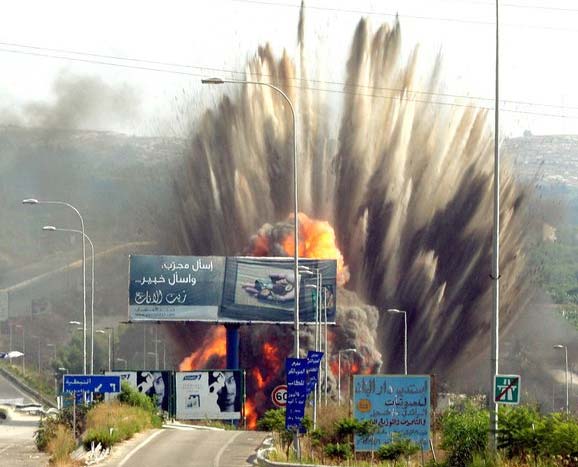
Last time around the U.S. encouraged this, what will Obama do?
Tuesday’s cross-border firefight between Israeli and Lebanese government forces might simply have been a misunderstanding. And the rockets fired from Gaza and the Israeli air strikes on the besieged territory over the past week could be viewed as periodic blip in business as usual on that front. By the same token, last Friday’s unprecedented joint visit to Beirut by the leaders of Saudi Arabia and Syria could be viewed simply as a move to stop the conflict between their Lebanese proxies turning nasty. And British Prime Minister David Cameron’s pleas to Turkey to keep open its communication channels with Israel’s leaders are quotidian diplomatic common sense. Viewed in a wider context, however, each of those events could be taken as signs of why many in the Middle East believe that despite the outward calm, the region may be on the brink of another catastrophic war. Continue reading
Another Remarkably Stupid NYT Op Ed on the Mideast

Okay, I don’t have much time here, it’s recycling night — and the New York Times seems to revel in recycling really tired Israeli PR lines. Today, it’s Ephraim Karsh trotting out a mish-mash of misrepresentations and tar-balls of wishful thinking to make the case that the Arab world has abandoned the Palestinians, and now that they’re on their own, they’re more likely to surrender to Israel’s terms at the peace table.
The evidence for this claim, first and foremost, is an unscientific survey by an Arab news organization that found that ” a staggering 71 percent of the Arabic respondents have no interest in the Palestinian-Israeli peace talks”. Uh, Ephraim, buddy — you may not know this, but the percentage of Palestinians that have no interest in those peace talks is probably higher. Nobody outside the Netanyahu-AIPAC echo chamber believes anything will come of such talks as long as the U.S. declines to force the issue with Israel. That’s hardly the same thing as saying the Arabs have tired of the Palestinians; on the contrary, most surveys of Arab opinion find the Israeli-Palestinian conflict remains their primary foreign policy concern. Arabs tiring of the Palestinians is wishful thinking. Continue reading
Posted in Situation Report
Tagged Abbas, Hamas, Israel, Karsh, Netanyahu, Obama, Palestinian, peace
61 Comments
On Iran, Liberals Are Enabling Another Disastrous War

Beinart chats with friends in high places: Liberal “hawks” like him played a major role in enabling the Iraq debacle
In 2003, the United States launched an unprovoked invasion of Iraq, a country that had neither attacked nor threatened it — and we, and the Iraqis, are still living with the consequences. Going to war in Iraq was made possible — easy, even — for the Bush Administration not only by Republican hawks and neocon extremists (the wannabe Army Corps of Social Engineers) baying for blood, but even more importantly, by supposedly sober and moderate liberal voices — the Peter Beinarts, Ken Pollacks, George Packers and the editors of the New York Times — not only failing to challenge the basic logic of the case for war, but providing their own more elegant (although equally brutal when stripped of their high-minded rhetoric) rationalizations for invading Iraq.
It was the liberal “hawks” and the New York Times, by failing to ask the right questions of the case for war, that did more to make the war a “thinkable” option for America than any neocon. They allowed the question to be posed simply as one of whether Saddam had weapons of mass destruction or not. And because nobody could give an absolute assurance in the negative, the argument became “better safe than sorry”. The liberals and the New York Times offered no challenge, and asked no questions, of the basic assumption that if Saddam had, in fact, had a couple of warehouses full of VX gas and refrigerator full of anthrax, that necessitated launching a war that has resulted in the deaths of hundreds of upward of half a million Iraqis (and thousands of Americans) and left America weaker and more vulnerable.
And the bad news is that they’re doing it again on Iran. Continue reading
Is War Talk Painting Obama Into a Corner on Iran?
 Despite the escalating war rhetoric, conventional wisdom holds that the U.S. military establishment and even President Obama himself believe that the potential consequences of a military strike that plunges America into a third war in the Muslim world are so grave — and the prospects for such a strike preventing or deterring Iran from eventually attaining nuclear weapons so dubious — as to render it too reckless an option. Nor is there any legal basis for it; a U.N. Security Council authorization for military action against Iran is unthinkable unless Iran attacked another country or was moving to do so. And most of the international community — including most of those countries that backed the latest round of sanctions — would strongly oppose it. President Obama is an indefatigable internationalist, and if he were planning to launch a military strike against Iran, it’s reasonable to expect that he’d be engaged in the protracted process of trying to establish a basis for such action at the U.N. and in international public opinion. No signs of that, at least not yet.
Obama has, however, insisted that a military option remains “on the table.”
How Do You Say ‘Duh!’ in Urdu?
 So how do you say “Duh!” in Urdu? There’s nothing new or remarkable in the suggestion that Pakistan’s Inter Services Intelligence agency (ISI) has been aiding and abetting the Taliban insurgency in Afghanistan, as highlighted in coverage of the massive leak of U.S. military documents published on Sunday. If anything, it’s conventional wisdom among Afghanistan watchers that Pakistan continues to treat the movement it helped bring to power in 1996 as a strategic counterweight against Indian influence on its western flank. The latest revelations, fantastical as some of them may be, are simply a discomforting affirmation that Pakistan, the beneficiary of $1 billion in U.S. aid every year, continues to pursue interests at odds with those of its Washington patron — just like everyone else in the Afghan war theater does. Contemporary American slang may not have easy Urdu equivalents, but Count Niccolo Machiavelli’s The Prince (“Badshah”) — the timeless handbook on duplicity and cunning in statecraft — was translated into Pakistan’s main language in 1947.
Abu Mazen and Obama’s Peace Pantomime
 Obama is unable to offer Abbas an independent Palestinian state based on the 1967 borders, because that is not what Netanyahu has in mind. Indeed, recent reports suggest that during his meeting last weekend with Egypt’s President, Hosni Mubarak, the Israeli prime minister presented a proposed map of a Palestinian State that fell well short of the Arab League’s proposal for peace. Nor is Netanyahu under pressure from the US to offer more. In fact, Netanyahu believes that he can bend Washington to his will, as he so memorably explained to a family of Israeli settlers in a recently surfaced video clip from 2001: “I know what America is. America is a thing you can move very easily, move it in the right direction.”
The “right direction” that Netanyahu made clear in the video, was “to put an end to this galloping forward to the ’67 borders”. Unable to offer a state based on the Arab League’s peace terms, Obama hopes to entice Abbas into his “peace event” by offering him a flag pole – specifically, the right to fly the Palestinian flag outside the PA mission in Washington. This is not any flag pole either, but one that provides diplomatic immunity for his envoys there: Palestinian diplomats will soon be able to ignore parking tickets in Washington, DC. Can the “stamps, parades and carnival” predicted by Uzi Arad be far behind?
Gone (World Cup) Blogging
object width=”400″ height=”245″>
Here’s a panel I did with friends a few weeks ago. For my daily World Cup musings, click on TIME.com’s 2010 World Cup Special. And you can also follow my relentless footie and political babble on Facebook and Twitter… Continue reading
What the Gaza Flotilla Tells Us About the Future of the Mideast

‘We’re the only ones who believe them,” a US official was quoted as complaining last week in response to Israel’s account of its attack on the Gaza aid flotilla.
The bloodshed on the high seas and the resulting diplomatic fallout is a reminder of just how far US influence has fallen in the region, and the grim prospects for the US president Barack Obama reversing that trend as long as the US continues to accord Israel special status.
Indeed, in a statement that would have evoked howls of protest had it been made on Capitol Hill, the Mossad chief Meir Dagan last week told a Knesset sub-committee that Israel is turning “from an asset to the United States to a burden”.
The drama of last week has forced the US and its European partners to concede that the Israeli blockade on Gaza is untenable, as is its underlying policy – shared by Washington and the Europeans – of refusing to engage with Hamas as an intractable fact of Palestinian political life.
The fact that a group of defiant civil society activists – backed by the Turkish government – has forced that acknowledgement is a sign of how far the balance of power in the Middle East has shifted.
It is a change that will also have implications for how the Iranian nuclear standoff is resolved. Continue reading
Posted in Situation Report
23 Comments
Has Globalization Stolen the World Cup Magic?

Who is this kid? Pele terrorizes Sweden in 1958
Nobody outside of Brazil had heard of the 17-year-old who exploded onto the international stage in the 1958 World Cup in Sweden with a display of skill, audacity, guile, vision and sheer exuberance that was to make Pele a global household name for the next half-century.
His status as the global symbol of football excellence was all the remarkable considering that the world only got to see him three more times at the quadrennial World Cup tournaments, culminating in 1970. Pele, after all, played his weekly club football for Rio De Janeiro’s Santos, whose games weren’t available on satellite TV.
There are many reasons why World Cup 2010 won’t surprise us with a new Pele, but the first should be obvious: today any teenager even half as talented would likely be on the books of Barcelona or Arsenal already, and therefore a familiar face to European club football’s massive global TV audience. Continue reading
Posted in Situation Report
Tagged 2010, Brazil, Drogba, Football, globalization, Pele, Soccer, World Cup
22 Comments
Scoring Round 1 of Hillary vs. Ahmadinejad

Walking out on Monday’s U.N. speech by Iran’s President Mahmoud Ahmadinejad may have been good domestic politics for the Obama Administration and its closest European allies, but it won’t necessarily help them prevail at the Non-Proliferation Treaty (NPT) review conference that began Monday. In fact the move by delegates from the U.S., Britain, France, Canada, Hungary, New Zealand and the Netherlands, among others, may have perversely played to Ahmadinejad’s advantage.
Continue reading
Posted in Situation Report
Tagged Ahmadinejad, Clinton, Egypt, Iran, Israel, NPT, nuclear, UN
20 Comments