

It is with unrestrained joy that I introduce my friend Balaji, a Madras-born scientist currently teaching at Princeton, who, in agreeing some months ago to write an analysis on the cultural and political subtexts of Australian umpire Darryl Hair falsely accusing Pakistan’s cricketers of ball-tampering, ended up delivering, as his first installment, this marvelous memoir of the personal and political meanings bound up in the clash of leather and willow. I love this piece, it got me thinking about my own memories of the game and the wider context in which we learned and played it. (But I’ll save those reflections for the comments sections, and I hope you will too)
Cricket’s Coded Conversation
by V. Balaji
Some 46 years ago this month at the Woolloongabba ground in Brisbane, there occurred an event until that time quite unique in cricket history: The first test match in the series between Frank Worrell’s West Indies and Richie Benaud’s Australians resulted in a tie. A tie may not seem like much, if football is your gig, but in five-day cricket it is quite extraordinary – a total of 737 runs was scored by each side, every man out twice with only one ball left to be bowled at sunset on the fifth day.
So extraordinary was the “Tied Test” that its oral history reverberated across the former British empire – of the feats of brilliance and the changes of fortune in a match that happened before my time, before television, in a country I’ve never visited, as a schoolboy I could quote chapter and verse: Gary Sobers’s electrifying first-innings century, his three fours in a single over against the always dangerous — and that morning, nearly unplayable — Alan Davidson; the Australian fight-back led by a flashy Norman O’Neill and a dour Bobby Simpson; and through twists and turns to the final day — Conrad Hunte’s 90-yard throw from the boundary to run out Davidson; Wes Hall dropping Neil Harvey’s return catch purely out of excitement and tension; Solomon, from 15 yards out at square leg, with only one stump visible, running out Meckiff with a direct hit, and the final image of the young Rohan Kanhai whooping and jumping up and down after the final out, not really knowing (no one really knew for a while) what the result was.
The legendary Barbados paceman Wes Hall remembers the tied test – with some of that classic footage the writer watched at school 15 years later
By some osmosis, and cricket’s oral tradition, we all knew about the Tied Test growing up, away in India, and a decade too late. Indian cricket, in those days, never amounted to much on the international stage; we were happy to adopt the West Indies as our stand-ins, where the handsome and dashing Guyanan Rohan Kanhai gave us an Indian face in which to see our own. (Two generations later, Rohan still remains a popular boy’s name among cricket-loving parents.) One memorable happening at school in Madras in 1971 was when the sports master somehow acquired a grainy 16-mm print of the Tied Test condensed into an hour: the whole school piled into the auditorium and watched it, nodding knowingly as the well-rehearsed events unrolled. A friend from those days recently confessed to me that he’d been absent at school that day, malingering from some minor illness, and cannot recall this even now without a gut-wrenching sense of loss.

Kanhai: “An Indian face in which to see our own”
Cricket always has had an epic quality to it, an ability to draw itself on a larger canvas. It is, frankly, more interesting to read about, talk about, and savor as a narrative after the fact: the actual experience of a Test match is composed of elements of carnival, crowd-watching, meals, and tedium. Jack Fingleton, a minor Aussie figure from the great Bradman sides of the 1930s, subsequently made a small career for himself as a cricket writer. His book about the 1960 tour of Australia by Worrell’s side, is called ‘The Greatest Test of All’, and captures a moment in which somehow, something transcendent occurred, and everyone, including the Australian public (recall that there were no Caribbean expats in Australia back then…), seemed for a moment touched by grace. When Worrell’s team left, after losing the series 2-1, they were given a send-off on the streets of Melbourne that included a motorcade and 100,000 people lining the sidewalks. Whoever heard of a ticker-tape parade farewell for losing visitors?
Fingleton himself ascribed the transcendence to something inherent in cricket itself. His book uses as its epigraph this verse from the obscure poet Henry Newbolt:
There’s a breathless hush on the Close to-night
Ten to make and the match to win
A bumping pitch and a blinding light,
An hour to play, and the last man in.
And it’s not for the sake of a ribboned coat.
Or the selfish hope of a season’s fame,
But his captain’s hand on his shoulder smote
“Play up! Play up! And play the game!”
“Playing the game,” “just not cricket”, “a straight bat”… Fingleton would argue that these phrases embody an entirely different philosophy of sport – and life – from the “Just win, baby!” of Al Davis’s Oakland Raiders. Cricket, alone of all sports, has “laws” instead of “rules,” and the laws are interpreted by an omniscient umpire, who’s always right, even when he isn’t. Even beyond that, cricket has a series of unwritten rules to live by. “Walking” – declaring yourself out when your bat had got the faintest fleeting touch to a ball caught by the wicketkeeper, even when the umpire had missed the fact and was ready to let you bat on – was the decent thing to do; it was “cricket.” Claiming a catch when you knew the ball had in fact touched the ground before you’d gathered it is “not cricket.” Fingleton argued that two teams had consistently and impeccably played the game the way it should be played, and that in fact was what had cast the golden glow over the 1960 tour.

The Trinidadian Marxist C.L.R James inevitably takes it a step further. His ‘Beyond a Boundary’ from 1963 is a tour de force of social analysis. Prescient in its application of dialectical materialism to the analysis of cricket as a cultural phenomenon, it anticipates by some years the “cultural studies” movement spearheaded by his fellow West Indian, friend, comrade and collaborator Stuart Hall. The book is quirky and brilliant, with odd contradictions abounding: quaint rolling constructions inherited from a colonial education (“he was as handsome a man as you could meet in a day’s journey…”) telling the story of how West Indians chafed under colonialism; a precise description of how racism functions in team selection devolving in the turn of a page to an account of George Headley (the “black Bradman”)’s bowel movements just prior to going out to bat. A committed Marxist analyzing colonialism through very detailed and personal accounts of individual men, and not only the content of their characters, but their cricket technique as well.

For James, the key to the 1960 tour was in the person of one man, Frank Worrell himself. Worrell was Jamesian socialism’s new man, the man constructed to be his own post-colonial future. Like no captain before him – he was, in fact, the first black man to captain the West Indies – Worrell led by example, and taught all his young team-mates to be new men as well. If he felt other batsmen were being unnecessarily cautious against innocuous bowling, he would promote himself up the order to go out and flay the attack; if he felt the track was beginning to turn, he would take upon himself a spell of spin bowling. Both in his cricket and off the field, Worrell held to his dignity with steel under his gentle demeanor. In his presence, James argues, no one could be less than their own better selves. Worrell taught everyone — teammates, opponents, spectators — how to play and enjoy cricket. It is in some sense a reprise of James’s argument about Toussaint L’Ouverture, in ‘The Black Jacobins,’ that the French themselves learned their droits de l’homme from the Haitian theorist of freedom.
Worrell’s ascension to the captaincy was itself a part of the anti-colonial struggle, one in which James played a central role. (James, it must be added, practised his cultural studies down at the barricades, not wallowing in the depths of an endowed chair.) Before Worrell, West Indies cricket labored under the colonial “wisdom” that black men were incapable of being captain: they supposedly lacked the qualities of command, strategic thinking, and holding their nerve under pressure. (Similarly, “Blacks can’t quarterback” was received wisdom in the U.S. until the Washington Redskins won a Superbowl in the 80s which owed everything to the leadership and unerring receiver selection of Doug Williams.) So, before 1960, West Indies sides were always led by a white man, often the only one in the side. The struggle for independence from Britain and the struggle to have Worrell appointed captain became one and the same, and both came to pass not least because of CLR James’s own brilliant polemics in newspapers and pamphlets. And captain Worrell did, with grace and acumen, always leading from the front. Acknowledging and commemorating independence, Britain knighted him, and Australia named the trophy for future West Indies-Australia tours for him, while he was still an active player: which is why in 1960 we could observe the spectacle of Frank Worrell handing the Sir Frank Worrell Trophy to Richie Benaud after losing the series.
So where does “Play up, play up and play the game!” fit in, then? James doesn’t take it quite in the same spirit of unreflective acceptance as does Fingleton. An extensive section of the book deals with Arnold (not sure of his first name… it is hard to imagine Arnold, a historical character immortalized in ‘Tom Brown’s Schooldays’, even having a first name, or a mother… he was headmaster, pure and simple. My illustrated copy of Tom Brown had a frontispiece of Arnold in pince-nez and gown leaning across his desk with upraised finger and exclaiming “You are expelled, Flashman!” That figure of the stern headmaster must have been the stuff of nightmares for every schoolchild in an authoritarian school system.). Headmaster of Rugby in the 1800s, he did more than anyone to plant and cultivate the mythos of “British pluck,” the “British sense of fair play,” and so on that were a staple of Boys’ World stories for a hundred years after. (Only in the 1960s did a subversive genre emerge, openly mocking these pretensions, most explicitly in the Flashman series of novels by George MacDonald Fraser.) A frankly stated aim of educating through sport was to prepare boys for a career in the Colonies. Cricket was to be yet another demonstration of British superiority over the natives. The brown and black races (and the French, for that matter…) did not have that innate sense of sport and fair play and must be taught it. Until they learnt, they couldn’t run their own states, they would need their white captain…
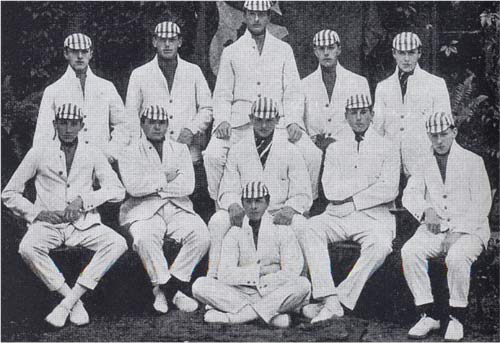
Colonial captains in the making: The First XI of Harrow School, 1910
But every such edifice carries within it the seeds of its own destruction. It wasn’t hard for us, unthinking, privileged youth within a colonial education system though we might have been, to see the hypocrisy in much of this. The basic fact was that the “white” cricket-playing nations didn’t actually appear to play cricket with anything like that mythic sense of sport. England were a dour lot, hating to lose, especially to Asian or Caribbean teams, and wouldn’t hesitate to delaying tactics barely within cricketing law in order to salvage a draw. And Australia and New Zealand were notorious for their biased umpires.
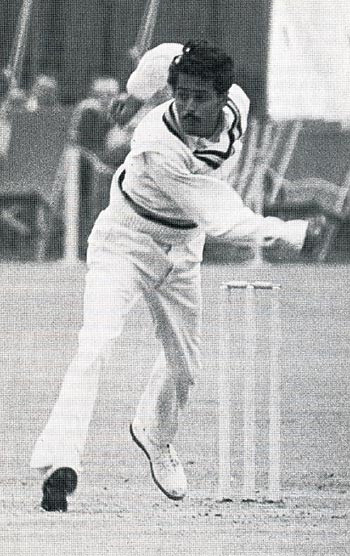
The inimitable Chandrasekhar
A famous story from those days has the normally mild-mannered B.S Chandrasekhar, who used an arm deformed by polio to become the most unpredictable of the legendary Indian spin quartet, appealing loudly after bowling an Australian batsman all ends up. (Many ways of getting out in cricket require the fielding side to appeal to the umpire for a judgment, but when you’ve knocked over the stumps, there’s really no two ways about it.) So the umpire turns to Chandra and says, “Well, he’s bowled, isn’t he?” And Chandra replies, “I know he’s bowled, but is he out?”
It’s probably too much to claim that it was stuff like this that sent some of us down the road leftwards… but there’s a germ of truth in there somewhere. That the West doesn’t live up to its stated values becomes obvious at one point or another, whether it’s sports or history, even if you’re fed a steady diet of Boys’ World and Biggles and the canon of dead European males. (Personally, my bookish path to the left went from John Stuart Mill to Bertrand Russell to Marx… with Engels, Haldane and Bernal to render my interest in science respectable. It wasn’t until much later that non-DEMs entered my world, Gandhi, Mao, Fanon, Sheila Rowbotham, not to mention C.L.R James…)
But just in case you were too dense to see it, the second verse from the Newbolt poem (not quoted by Fingleton) drives the point home:
The sand of the desert is sodden red-
Red with the wreck of the square that broke
The gatling’s jammed and the colonel dead,
And the regiment blind with dust and smoke.
The river of death has brimmed its banks,
And England’s far, and Honour a name,
But the voice of a schoolboy rallies the ranks-
“Play up! Play up! And play the game!”
No points for guessing where this is set: clearly the schoolboy is wandering somewhere well east of Eton. And he’s still there, except now the grounds are marked out with “Scimitar tanks and ASLAV armored vehicles”, and everyone now and then they’ve had to call off the match because a “Merlin helicopter caused a sandstorm by landing nearby.”
So, will cricket stiffen the spine of the the boys in Basra? Check back with us in Part II, coming soon…
37 Responses to Cricket’s Coded Conversation