
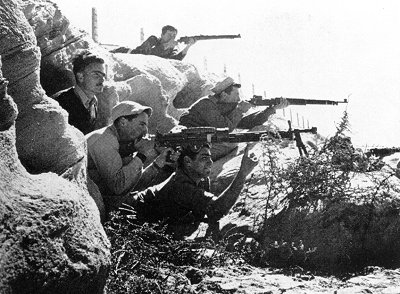
Haganah fighters take aim: Survivors of the camps arriving in Israel in 1948 having been denied anywhere else to go weren’t going to see the war as anything but a matter of physical survival
No, this is not another one of those idiotic diatribes by Americans or Israelis who know nothing about Nelson Mandela, but use their fantasy picture of him to add authority to their claims that the Palestinians should embrace whatever Israel deigns to offer them. For the record, in making peace with the apartheid regime, Nelson Mandela did not significantly compromise on the ANC’s core demand – he agreed to end the armed struggle only when the white minority had conceded to the principle of democratic majority rule after decades of trying in vain to force the national liberation movement to settle for less.
Still, there is a very, very important lesson that the Palestinian national movement and its Arab allies – and certainly, those in Iran who claim to speak on its behalf – have failed to learn. Mandela made it his business, as a responsible leader of a national liberation movement fighting apartheid’s unique form of colonialism, to understand the motives of the system’s die-hard supporters. Not simply their tactics and strategies, but the historical narrative within which they constructed their system of minority rule as an “historic necessity” by which they could justify the suppression of others. Because all systems of oppression are ultimately founded on fear, and their claim to offer protection to their adherents from the things they most fear.
When Mandela stood in the dock in 1964 and told the court that one of his prime sources of inspiration for waging guerrilla war was the great Boer War general Deneys Reitz — whose book “Kommando” was an early manual worthy of Giap — he was not simply being cute. He was telling the Afrikaners that he connected with their own national liberation struggle waged against the British, and that he was representing his own people in a narrative they should understand from their own experience. The Boers built the system that guaranteed their privileges and power on the basis of the common historical experience of the Afrikaners at the hands of the British – and for those of you who didn’t know, the very term “Concentration Camp” was actually a British invention during the Boer War. The highly mobile Boer guerrilla forces were more than a match for Britain’s large conventional formations, saddling up and riding into battle and then simply disappearing back into the civilian population. So the British responded by simply rounding up that civilian population, burning their farms, and imprisoning them in what they called “Concentration Camps,” where 26,000 Boer women and children died of starvation and disease.
And it was that sense of victimhood and outrage at the hands of the Brits that drove the Afrikaner-Nationalist ideology of Mandela’s foes. Both from prison and in power, Mandela never belittled or dismissed their experience; instead he honored the suffering of the Boers and their courage and ingenuity in their war against Britain. Mandela’s message, in essence, was “we understand your suffering, but we were not your oppressors, and you have nothing to fear from us; your suffering cannot excuse the suffering you have imposed on us.”

Mandela went out of his way to incorporate Afrikaner suffering, and even Afrikaner national pride, in his articulation of a new national identity. The ANC government celebrated the centenary of the Anglo Boer war in 1999, commemorating it as part of the legacy of South Africans’ fight for freedom. And five years earlier, Mandela had donned that most potent of symbols of Afrikaner pride — the Springbok rugby jersey — to cheer on the national team at the Rugby World Cup, a gesture more powerful than any words could convey to many ordinary Afrikaans people fearful of their place in Mandela’s new South Africa.
The reason we’re talking about this, of course, is that Iran is hosting an international gathering of Holocaust deniers, as if assembling a rogues gallery of neo-Nazis and Klu Klux Klansmen to “negate” the experience of history can somehow strengthen the Palestinian cause. In truth, of course, President Mahmoud Ahmedinajad is not concerned with the Palestinians; he’s fighting his own power struggle against more pragmatic elements inside the regime in Tehran, his strategy involving repeat symbolic provocations of the West in order to foment a crisis that sabotages the efforts of those in the regime seeking a pragmatic coexistence. His tactics are those of the 1979 U.S. embassy seizure — create a confrontation with the West that polarizes the situation, forcing Iranians to rally against an external enemy and sabotaging any effort to cooperate with the U.S. and others.
And in inviting Palestinians and Arabs to deny the Holocaust, Ahmedinajad is doing their cause a profound disservice. Ahmedinajad’s Holocaust-denial is hardly unique. It’s been echoed even in recent weeks by representatives of Egypt’s Muslim Brotherhood, and even Mahmoud Abbas — although he has since disavowed it — wrote a PhD thesis in the early 1980s in which he claimed that the number of Jews killed by the Nazis was less than 1 million.
This offends me profoundly, as a Jew, as an advocate of justice for the Palestinians, as a global citizen. Because even if Holocaust denial arises among Arab intellectuals largely as a result of the uses to which the Zionist movement has put the Holocaust to justify all manner of injustices against the Palestinians, that does not excuse it. To deny the Holocaust becuase of the way it has been exploited is like denying that the attacks on the World Trade Center took place because you don’t like the Patriot Act or the way 9/11 has been used to cow a frightened nation into supporting the invasion of Iraq.
Arab Holocaust denial is a feeble-minded distortion that puts its adherents into the bizarre company of people who today would just as soon butcher Muslims to get them out of Europe as they once did to Jews (or, indeed, of the diseased minds in the Zionist camp who spend all their time bashing out emails and journal articles purporting to show that there are no Palestinians, that Edward Said never lived in Jerusalem and that sort of thing…). But that’s not the worst of it: Arab Holocaust denial also evades confronting the fact that not only did the Holocaust happen to the Jews of Europe, but because it happened to the Jews of Europe — and because of the reaction by other Western powers before and after the fact — the Holocaust profoundly changed the Arab world. Indeed, in this sense, the Holocaust may have been one of the most important historical events shaping Arab history over the past century.
No, Ahmedinajad would say, not the Holocaust, but the “myth” of the Holocaust. But does he think we’re stupid? The vast majority of the world’s Jews before World War II had rejected Zionism and its idea of colonizing Palestine in order to build a Jewish nation-state as a fringe movement of zealots. In terms of Jewish political affiliation, Zionism accounted for less than 20 percent. The vast majority of Europe’s Jews had identified themselves with the parties of the Left (and also secular liberalism in the case of elements of Western Europe’s more prosperous Jewish communities) — they were socialists and social democrats, Bolsheviks and Bundists (the Jewish Workers Bund was a Yiddish-speaking organization for Jewish workers but aligned itself with the broader socialist movement, as compared with the entirely secular currents of Bolshevism in which many Jews participated, but as individuals rather than en bloc).
And, of course, among the massive Jewish population of the main Arab cities of the time, such as Cairo and Baghdad (and also Tehran, of course, which is not Arab, but Persian), there was no statistically significant presence of a Zionist movement at all. And it is important to remember, here, that it was in the Muslim world that Jews had historically sought refuge from persecution in Christian Europe, at whose hands Jews and Muslims shared a common fate.
The Holocaust wiped out the pre-war (mostly anti-Zionist) European leadership, and the Zionists were ready to take advantage of the opportunity presented by universal horror at what had transpired in the camps to make a case for a Jewish State in Palestine — a cause for which they had fought long before the Holocaust, but in which they hadn’t won the support of a majority of European Jews. Ben Gurion notoriously remarked, circa 1938, “‘Were I to know that all German Jewish children could be rescued by transferring them to England and only half by transfer to Palestine, I would opt for the latter, because our concern is not only the personal interest of these children, but the historic interest of the Jewish people.” Indeed, Ben Gurion warned that as a result of universal outrage at the Kristallnacht pogrom, other nations might be moved by conscience to open their doors to Jewish refugees — “Zionism is in danger!” Ben Gurion warned.
Indeed, after the war, the Zionist movement actively agitated to ensure that the survivors of the Holocaust were transferred to Palestine, and nowhere else. Morris Ernst, a Jewish adviser to President Roosevelt, wrote later of a plan he devised and had pressed the U.S. president to accept that would throw open the doors of the U.S. to at least 150,000 survivors. “It would free us from the hypocrisy of closing our own doors while making sanctimonious demands on the Arabs,” Ernst wrote, in reference to the fact that Arabs in Palestine were being told to make room for the survivors, while the main Western powers kept a tight restriction on Jewish immigration even after Auschwitz. When he proposed the plan to Zionist activists in Jewish organizations, he was shocked at the reaction: “I was amazed and even felt insulted when active Jewish leaders decried, sneered, and then attacked me as if I were a traitor…I think I know the reason for much of the opposition. There is a deep, genuine, often fanatical emotional vested interest in putting over the Palestinian movement [i.e. the move to settle Jews there].”
And in his excellent book The Seventh Million: Israeli Jews and the Holocaust, Israeli historian Tom Segev reveals that for the first 15 years after the liberation of the camps, Israelis were not much interested in hearing the testimonies of Holocaust survivors or discussing an episode they saw simply as connoting Jewish weakness. It was only after the Eichmann trial in Jerusalem that Israel began to actively claim ownership of the Holocaust as part of its national narrative, and the reason was political: the first generation of Western Jews who had settled in the new state was beginning to lose faith and emigrate, and a sense of gloom had settled over the Zionist project — reviving the memory of the Holocaust became a way of promoting national unity behind Zionist goals. (And my personal Zionist experience was intimately bound up with the Holocaust, and the sense the Zionist movement had created in me that we were always on the brink of extinction, and that Israel embodied the spirit of the Warsaw Ghetto, of not going meekly to the gas chamber — take a 17-year old to Yad Vashem, then tell him that our only insurance against another Holocaust is the IDF, and you’ll add another true believer to the ranks.)
For the Palestinians and their supporters, however, the point is simple: The memory of the Holocaust is such a powerful ideological tool for Zionism precisely because of its reality — it speaks the collective memory of Ashkenazi Jews of our fate in Europe, and it pricks the conscience of the perpetrators and those who preferred to turn away.
To respond by trying to deny the reality of the Holocaust is as profoundly immoral as it is idiotic — creating a kind of binary game in which if Israel says mother’s milk is good for babies, the likes of Ahmedinajad will convene a symposium to prove the superiority of formula. The point about the Holocaust is that it happened to the Jews of Europe, and afterwards, as a result of the efforts of the Zionist movement and some combination of shame and latent anti-Semitism in the West, many of its survivors had no choice but to go to Palestine, where they were willing to fight with every fiber of their being for survival, without the luxury of considering the history and context into which they’d been thrust. In the war that followed, Palestinian Arabs, who had been 55 % of the population and had controlled around 80 % of the land, now found themselves displaced and dispossessed, confined to a mere 22 % of Palestine (the West Bank and Gaza), and prevented by a series of ethnic-cleansing laws passed by the State of Israel at its inception from reclaiming the homes and land from which they’d mostly fled in legitimate fear of their lives.
So, the Holocaust, in a very real way, reverberated traumatically in Palestinian national life: It was the narrative that fueled the ferocity with which many of those who drove the Palestinians from their homes in 1948 approached the struggle. And, as Morris Ernst wrote in his reference to “sanctimonious demands on the Arabs,” the Palestinian Arabs had been asked to pay a steep price for Western guilt over what had befallen the Jews of Europe.
Ahmedinajad ought to pay attention to one particular guest, a Palestinian lawyer from Nazareth called Khaleed Mahameed, who runs a small Holocaust exhibit at his office in Nazareth, and argues that it is essential that the Palestinians understand the Holocaust because in it lies the root of their own suffering. Addressing the Israelis on the basis of an understanding of their experience was essential for the Palestinians to make progress in their own national struggle, he argues. He was invited to the conference after writing to Ahmedinajad telling him that the Holocaust was an historical fact that should not be questioned, and that doing so only played into the hands of right-wing Zionists. Indeed, the Zionist establishment doesn’t quite know what to make of Mahameed, because he’s directly challenging Ahmedinajad at the same time as making clear that the Holocaust has been abused in order to justify suffering inflicted on the Palestinians. That’s how a Palestinian Mandela would put it — the Holocaust, in fact, is part of the legacy of suffering that is the common history of Israel and the Palestinians.
Pingback: OBAMA, THE HOLOCAUST AND THE PALESTINIANS « INTIFADA