
Published in the sadly departed Japanese food culture magazine Eat in May 2001
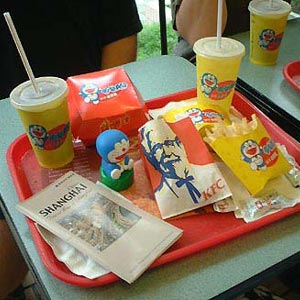
This time around, the Colonel kept his head. Local police in China’s Hunan province had been braced for the worst during the Hainan spy-plane standoff earlier this year, remembering how angry crowds vandalized two Kentucky Fried Chicken outlets after the 1999 U.S. bombing of China’s Belgrade embassy. One group of rioters had even beheaded a statue of the chicken chain’s affable icon, having mistaken Colonel Sanders for a representation of Uncle Sam.
The reason the Colonel kept his head this time was not because the Chinese were any less angry with the U.S. than in 1999. But even the staunchly nationalist residents of Beijing and other cities have begun to make KFC and McDonalds their own. Throughout the Hainan crisis, Western reporters in China found those restaurants filled with consumers happily munching on Big Macs or fried chicken even as they excoriated the United States.
“McDonald’s means America, but it also means China, too,” engineer Wang Zishen told a Washington Post reporter while buying his son a burger in Beijing. “Of course, we are angry at the United States, but that doesn’t stop my boy from liking McDonald’s.”
The distinction made by Wang, of course, is the Holy Grail of those responsible for marketing McDonalds to a diverse, yet divided world – a task which requires patience, determination and some skillful political and cultural gymnastics. Because the Golden Arches have become a kind of universal lightning rod for anti-U.S. rage. McDonalds has been the target of protests, sometimes violent, in more than 50 different countries over the past six years – invariably over issues that have nothing whatsoever to do with the fast-food chain.
French farmer-activist Jose Bove, protesting U.S. trade sanctions against his foie gras, famously trashed a small-town McDonalds three years ago. Serbs protesting NATO’s bombing of Belgrade did the same a year later (while their supporters in Rome actually bombed three of that city’s outlets). For Mexico City residents denouncing U.S. immigration policy in 1994, Danish anarchists who’d simply had enough of capitalism in 1996 – whatever the issue, McDonalds was the target.
Thus the wages of globalization: Ronald McDonald and Colonel Sanders takes a bullet for Uncle Sam. Partly, they’re victims of their own success – U.S. fast-food outlets are such a tempting target precisely because there are so many of them. Most of McDonalds revenues today come from outside the U.S. A new outlet opens somewhere in the world every 17 minutes — during the Hainan standoff, there were reportedly 87 McDonalds restaurants operating in Beijing, alone.

Belgrade McDonald’s
And where globalization’s cheerleaders once thought that spread might ease global tensions — “No two countries that have McDonalds have ever fought a war” was a U.S. media mantra until 1999, when the Kosovo conflict saw U.S. planes bombing Belgrade, a city with seven McDondalds outlets – instead McDonalds, KFC and other chains find themselves feeding an ever-divided world. And for the most part, they’re welcomed, even in climes quite hostile to their homeland. Ronald McDonald and the Colonel do occasionally take lumps, of course, but only when they’re taken to symbolize American power.
And so, the challenge of marketing Ronald or the Colonel abroad is to make sure they’re not mistaken for Uncle Sam. The basis of McDonalds’ advertising all over the world is to associate their brand with the heroes, causes and experiences treasured by their target markets. Link your logo with the consumer’s own values, preferences and tastes, and the market is yours for the taking.
That explains why the Big Mac is touted as the “Official Sandwich” of the Olympic Games. Or why the company makes promotion deals with Disney kiddie movies, or uses the hottest new baseball or basketball star in its commercials. It may also explain why the Saudi Arabian license-holders for McDonalds came up with a unique promotion during Ramadan – giving 25c (American) out of every sandwich sold to that country’s ‘Al Quds Intifada Fund,’ which supported Palestinian children’s hospitals swamped with casualties of the uprising that began last October.
It may not have been a promotional initiative likely to picked up by the parent company back home in an overwhelmingly pro-Israel culture, but it made business sense in a Saudi market where anger at the plight of the Palestinians was directed as much at the United States as at Israel – and threatened to spawn a boycott of all products associated with America. Thus the concern of Mohammed Emam, marketing coordinator of McDonalds, Jeddah, who told a Saudi newspaper, “We want to prove to people that even though McDonalds is an American franchise, it cares about the plight of the Palestinians.”
James Cantalupo, currently President of McDonalds, had said in 1991 that the company’s strategy in each of its global operations was to become “as much part of the local culture as possible.” And in Saudi Arabia, that meant being seen to do your bit for the Palestinians. Such sensitivities, of course, can be double-edged for the parent company, as Burger King found out two years ago. Under threat of a pan-Islamic boycott after an outlet was opened at an Israeli settlement in the occupied West Bank, the company withdrew its franchise from the food court in question, only to be threatened with a counter-boycott in the U.S. by angry pro-Israel elements.
Sometimes, a brand even has to bite the hand that reared it. McDonalds in France, two years ago, ran a series of ads designed to identify the Global Arches with Europe’s efforts to block the import of hormone-laced American beef. “What I don’ t like about McDonalds France,” says an overweight U.S. cowboy in one, “is that it doesn’t buy American beef.” The ad specifies that French McDonalds only uses French beef, to “guarantee maximum hygienic conditions.”

McThai menu adaptations
But even beyond such overtly political sensitivities, building a brand across borders can be a major cultural challenge. And the fast-food chains may have learned from the original globalizing corporation, the Catholic Church. As it ventured out into new worlds, the Church adapted to indigenous tradition and belief all over the world and often found itself inexorably reshaped by its host cultures. Likewise, McDonalds: If your Mac tastes a little different in India, that’s because it’s a “lamburger” – eating beef offends Hindu tradition. In Thailand, besides the standard lineup of burgers, you can order a “Samurai Pork Burger,” in the Philippines you can add a “MacSpaghetti” to your tray. In Beijing the menu includes spicy chicken wings and red bean pie, while the Big Mac is known by the altogether more grandiose title of “Lu Wu Ba” (“huge incomparable warlord”).
But the key to “indigenizing” McDonalds, KFC and other American fast food chains around the world is generational. If you grew up eating McDonalds in Tokyo or Manila, chances are you don’t even think of it as foreign – it’s always been part of your experience. Hence the familiar tale of Japanese kids visiting the U.S. and marveling that America, too, has the Golden Arches. Older Muscovites may have queued for hours in 1991 to taste the forbidden fruit when the Golden Arches first marched into post-Soviet Russia, but the next generation will know it simply as a local burger joint in which the staff smile more often than is the norm in Russia.
The generation of young Chinese who grow up eating at “Mai Dang Lao” are unlikely to even be aware that their “huge incomparable warlord” has a double life. And if they find occasion to mount anti-American demonstrations outside the U.S. embassy, they’ll think nothing of stopping at the Golden Arches for a red bean pie on their way home.
12 Responses to Colonel Sanders Keeps His Head